- Your cart is empty Browse Shop
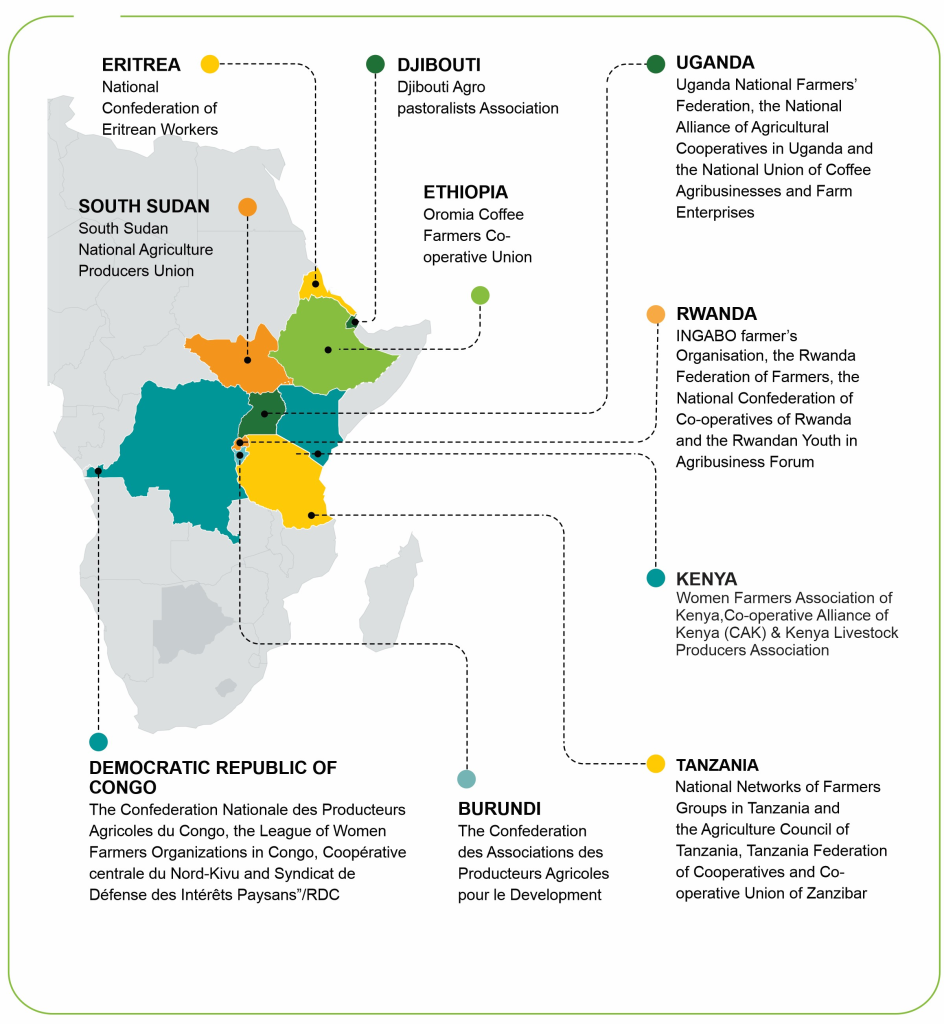
Our members across Eastern Africa
EAFF membership comprises apex farmer associations, co-operatives and commodity associations in 10 countries across Eastern Africa (Kenya, Uganda, Tanzania (Zanzibar), Rwanda, Burundi, Ethiopia, Djibouti, DR Congo, South Sudan and Eritrea).
These organisations are the direct voice of millions of smallholder farmers, pastoralists and agro-pastoralists in the region, and form the foundation of EAFF’s collective advocacy and programmatic work.
Our Member Countries by Data
Ethiopia
- Oromia Coffee Farmers’ Cooperative Union (OCFCU)
The Oromia Coffee Farmers Cooperative Union (OCFCU) is one of Ethiopia’s largest and most influential coffee cooperatives. Established on 1 June 1999, it was founded by 34 primary cooperatives representing approximately 22,000 farmers in the Oromia Region, the birthplace of Arabica coffee. As of 2024, the Union has grown to encompass 413 member cooperatives representing over 562,000 coffee farmers, including more than 64,000 women. OCFCU processes and exports high-quality organic coffees and holds multiple international certifications including Fair Trade, Organic, and Rainforest Alliance. Key Functions: • Direct export of certified organic and Fair-Trade coffee to global markets • Financial services and pre-harvest financing to member cooperatives • Training in sustainable, organic, and bird-friendly farming techniques • Value addition through processing plants and the OneKoo Coffee roasting facility • Social investment including school construction and community development 🔗 For More Information: www.oromiacoffeeunion.com |
Uganda
2. National Union of Coffee Agribusinesses and Farm Enterprises (NUCAFE)
The National Union of Coffee Agribusinesses and Farm Enterprises (NUCAFE) is an umbrella national coffee farmers’ organisation founded in 1995 and has since evolved to become the largest employer in Uganda’s coffee industry. NUCAFE uses its unique Farmer Ownership Model to empower smallholder farmers to assume greater roles along the entire coffee value chain, from farm processing to manufacturing and exporting. The organisation’s membership spans over 188 farmer organisations representing more than 200,000 farming households and over 1,000,000 individual smallholder coffee farmers across all coffee-growing regions in Uganda.
Key Functions:
- Empowering farmers through the Farmer Ownership Model across the full value chain
- Technical skills training, business development, and governance training
- Coffee processing, value addition, and market access including a Kampala coffee shop
- Advocacy for smallholder farmer-friendly policies
- Digital tools and ICT support for agribusiness development
🔗 For More Information: nucafe.org
3. Uganda National Farmers Federation (UNFFE)
The Uganda National Farmers Federation (UNFFE) is the largest non-governmental farmer organisation in Uganda. Founded in January 1992 and restructured into a Federation in 2002, UNFFE is non-religious and non-political, serving all Ugandan farmers. UNFFE operates through a well-structured network from Special Interest Groups at village level up through parish, sub-county, and district levels to the National Farmers Council. The Federation connects farmers to inputs, advisory services, affordable financial service providers, markets, and forward and backward linkages along different value chains.
Key Functions:
- Policy lobbying and advocacy for farmer-friendly legislation at national and regional levels
- Connecting farmers to inputs, markets, and financial services
- Capacity building and governance training for farmer organisations
- Representing farmers at national, regional, and international forums
- Market linkages and value chain development across diverse agricultural commodities
🔗 For More Information: unffe.org.ug
4. National Alliance of Agricultural Cooperatives in Uganda (NAACUG)
The National Alliance of Agricultural Cooperatives in Uganda (NAAC) is an umbrella organisation of all agricultural cooperatives in Uganda. Founded in January 2018 and formally registered as a legal entity in 2019, NAAC was established to fill an identified gap in access to support services by agricultural cooperatives. As a member-founded, member-owned, member-controlled, and member-benefitting organisation, NAAC provides customised support to agricultural cooperatives, amplifies their collective voice, coordinates support services for cooperative growth, and lobbies government for favourable policies.
Key Functions:
- Customised support services to agricultural cooperatives across Uganda
- Lobbying government for favourable cooperative policies and regulations
- Networking with local and international agribusiness actors
- Capacity building and cooperative governance and management support
- Coordinating shared services for cooperative growth and member prosperity
🔗 For More Information: naacug.org
Kenya
5. Women Farmers Association of Kenya (WoFaAK)
The Women Farmers Association of Kenya (WoFaAK) is the national umbrella organisation of women farmers in Kenya. Registered in 2017 under the Societies Act, WoFaAK is a non-political, non-government, and non-religious member-based organisation. It provides Kenya’s women farmers with a platform to articulate issues affecting them in agriculture, empowering them to increase food and nutrition security and incomes through its three core pillars: Capacity Building, Mentorship, and Entrepreneurship Development.
Key Functions:
- Capacity building for women farmers in agricultural best practices and business skills
- Mentorship programmes connecting women farmers with experienced agricultural champions
- Entrepreneurship development and wealth creation for women in agriculture
- Policy advocacy to improve conditions for women in Kenya’s agricultural sector
- Network and market linkage creation for women farmer groups across Kenya
🔗 For More Information: wofaakenya.org
6. Kenya Livestock Producers Association (KLPA)
The Kenya Livestock Producers Association (KLPA) was formed in 2004 as the apex association for all livestock producers in Kenya. It draws membership from individual farmers, farmer groups, cooperative societies, Self Help Groups, Community Based Organisations, and corporate organisations in livestock agribusiness. Today, KLPA represents more than 1,500,000 farmers spread across all of Kenya and has founded the North Eastern Africa Livestock Council (NEALCO) to promote regional livestock trade.
Key Functions:
- Policy lobbying and advocacy for Kenya’s livestock producers
- Organising county-level agribusiness trade fairs (over 308 events across Kenya)
- Facilitating access to farm inputs and financial services for livestock farmers
- Digital agriculture platforms for market information and input access
- Regional livestock trade promotion through NEALCO
🔗 For More Information: www.klpakenya.org
7. Co-operative Alliance of Kenya (CAK)
The Co-operative Alliance of Kenya (CAK) is the National Apex Organisation for Kenya’s Co-operative Movement. Its membership is drawn from over 25,000 registered cooperatives with individual members exceeding 14 million and mobilised savings of over KShs 250 billion — representing approximately 30% of national savings. CAK’s mandate is to lobby for a favourable and enabling policy environment for cooperatives, promote cooperative development, unite the cooperative movement, and represent cooperative interests on all policy matters.
Key Functions:
- Policy lobbying and advocacy for Kenya’s cooperative movement at national level
- Leadership and governance capacity building for cooperative societies
- Publishing the quarterly Co-operative Magazine for sector communication
- Representing cooperative interests at national and international forums
- Promoting supportive legal frameworks and cooperative legislation reform
🔗 For More Information: www.cak.coop
8. Kenya National Farmers’ Federation (KENAFF)
The Kenya National Farmers’ Federation (KENAFF) is the apex umbrella farmers’ organisation in Kenya, founded in 1946. KENAFF is a non-political, non-profit, and democratic membership-based organisation whose core mandate is to represent, articulate, promote, and protect the interests of Kenyan farmers through lobby, advocacy, policy action, and farmer empowerment. The Federation represents approximately 2 million farm families across Kenya. In 2026, Kenya will host the World Farmers’ Organisation Annual Meeting — a landmark achievement championed by KENAFF.
Key Functions:
- Representing and advocating for Kenya’s farmers at national and international levels
- Lobby and policy action on agricultural, trade, and land legislation
- Capacity building through farmer training and the KENAFF Farmers Institute
- Facilitating access to agribusiness services, markets, and financial services
- Youth and women empowerment in agriculture through dedicated councils
🔗 For More Information: www.kenaff.org
Tanzania
9. MVIWATA — Mtandao wa Vikundi vya Wakulima Tanzania
MVIWATA is the National Network of Smallholder Farmers Groups in Tanzania and was founded in 1993 by 22 innovative farmers from seven regions and is the largest smallholder farmers’ grassroots movement in Tanzania. With branches in all regions of mainland Tanzania and Zanzibar, MVIWATA unites farmers in groups and networks to defend their economic, social, cultural, and political interests. Its guiding motto is “Mtetezi wa Mkulima ni Mkulima Mwenyewe” — the defender of a farmer is the farmer themselves.
Key Functions:
- Uniting smallholder farmers for collective advocacy and policy dialogue
- Lobbying for land rights, fair prices, and economic justice for smallholders
- Strengthening farmer groups and networks from grassroots to national level
- Agroecology promotion and sustainable agriculture training and market centres
- Market facilitation and linking farmers to better prices across value chains
🔗 For More Information: www.mviwata.or.tz
10. Tanzania Federation of Co-operatives (TFC) Limited
The Tanzania Federation of Co-operatives (TFC) Limited is the national cooperative umbrella organisation that promotes, serves and coordinates the work of cooperative societies in mainland Tanzania. Registered in December 1994, TFC currently comprises 70-member organisations representing approximately 4,000 cooperative societies across the country with around 4,000,000 individual members in sectors spanning maize, rice, coffee, tea, dairy, tobacco, cotton, and more. TFC is a member of the International Co-operative Alliance (ICA) and EAFF.
Key Functions:
- Promoting and coordinating cooperative society development across mainland Tanzania
- Policy lobby and advocacy for the cooperative sector at national level
- Cooperative education and public awareness programmes
- Supporting improved legal, economic, and institutional environments for cooperatives
- Connecting cooperatives to regional and international cooperative networks
🔗 For More Information: ushirika.co.tz
11. Agricultural Council of Tanzania (ACT)
The Agricultural Council of Tanzania (ACT) is the umbrella private sector organisation advocating and lobbying on behalf of its members on policy and business environment issues impacting the agricultural sector. Established in 1999, ACT draws members from farmers’ associations, livestock keepers’ associations, cooperatives, input suppliers, agro-processors, and researchers. ACT serves as a neutral broker coordinating Tanzania’s agricultural private sector and is a member of EAFF, the East Africa Business Council (EABC), and SACAU.
Key Functions:
- Policy advocacy and lobbying for Tanzania’s agricultural private sector
- Coordinating public-private partnerships in agriculture (PPPs)
- Facilitating market linkages and agricultural value chain development
- Supporting access to finance and financial services for farmers and agribusinesses
- Promoting gender and youth inclusivity across the agricultural sector
🔗 For More Information: www.actanzania.or.tz
Rwanda
12. Rwanda Youth in Agribusiness Forum (RYAF)
The Rwanda Youth in Agribusiness Forum (RYAF) was officially launched on 3 May 2016 as a nationwide forum for youth involved in agriculture. Formed under the initiative of the Government of Rwanda through the Ministry of Agriculture and Animal Resources, RYAF operates in all 30 districts of Rwanda with over 3,700 members and more than 3,200 registered agribusinesses. RYAF brings together youth organisations, individual young farmers, and entrepreneurs in crop production, livestock, agro-processing, inputs, agro-services, and ICT for agriculture.
Key Functions:
- Mobilising and empowering youth to engage profitably in agribusiness
- Connecting youth agripreneurs to markets, finance, and technology
- Policy advocacy for youth-inclusive agricultural development in Rwanda
- Access to market services through partner buyers and RYAF member shops
- Building a critical mass of youth change agents in Rwanda’s agricultural transformation
🔗 For More Information: ryaf.rw
13. Ingabo Farmers’ Syndicate
Ingabo Farmers’ Syndicate is a Rwandan farmers’ own-voice organisation that advocates to promote sustainable agricultural profession and farmers’ interests. Its aim is to ensure farmers are heard on key decision-making platforms and are recognised as partners, not merely beneficiaries, in agricultural development. Ingabo has been particularly active in the cassava value chain, hosting its annual Cassava Week event.
Key Functions:
- Advocacy for farmers’ professional interests, rights, and voice in policy
- Boosting cassava productivity through improved seeds and agroecological training
- Organising annual Cassava Week events for stakeholder engagement
- Promoting climate-smart and agroecological farming practices (e.g. ZAI pits)
- Connecting farmers to cooperative management training, finance, and markets
🔗 For More Information: ingabosyndicate.org
14. IMBARAGA Farmers Organisation
IMBARAGA is a National Farmer Organisation from Rwanda created in 1992, working to improve the socio-economic conditions of an estimated 27,300 farmers in 25 out of 30 districts across the country. Originally established as a trade union organisation, IMBARAGA transitioned to a local NGO in 2013 while maintaining its founding mandate of protecting farmers’ rights and interests. The organisation trains up to 200 farmers per day at its Musanze training centre, with 22 full-time and 50 part-time agronomists.
Key Functions:
- Training farmers in the latest agronomic practices and cooperative management
- Linking farmers with viable markets and agribusiness buyers
- Assisting farmers to adopt new agricultural technologies
- Policy advocacy for pro-farmer legislation in Rwanda
- Capacity building and cooperative governance support across 25 districts
🔗 For More Information: imbaraga.org
15. National Cooperative Confederation of Rwanda (NCCR)
The National Cooperative Confederation of Rwanda (NCCR) is the umbrella organisation that promotes and represents the interests of the cooperative movement in Rwanda. NCCR serves as the apex body for Rwandan cooperatives, coordinating activities across all cooperative sectors and advocating for a favourable policy and legal environment for cooperative development. NCCR works closely with the Government of Rwanda and international cooperative bodies to strengthen the sector and ensure cooperatives contribute meaningfully to Rwanda’s socio-economic development goals.
Key Functions:
- Representing and advocating for the interests of Rwanda’s cooperative movement
- Promoting cooperative education and awareness across all sectors
- Coordinating cooperative sector development at national level
- Liaising with government and international cooperative organisations
Supporting cooperative governance and capacity building
Burundi
16. Confederation of Associations of Agricultural Producers for Development (CAPAD)
The Confederation of Associations of Agricultural Producers for Development (CAPAD) is Burundi’s leading national peasant organisation, created in 2000. Over more than 20 years of operation, CAPAD has grown to unite more than 200 associations and agricultural cooperatives across the entire Burundian territory, representing over 107,000 family farming households, 62% of which are headed by women. CAPAD works for agricultural transformation, promoting sustainable, resilient and competitive agriculture across food crops, fruits, vegetables, and livestock sectors in 68 municipalities across 15 provinces.
Key Functions:
- Strengthening capacities of peasant organisations and cooperatives in Burundi
- Supporting sustainable agricultural production and agroecology practices
- Facilitating commercialisation and value addition of agricultural produce
- Policy advocacy and rural governance (plaidoyer) for farmers’ interests
- Promoting women’s leadership and cooperative management consolidation
🔗 For More Information: www.capad.info
DR. Congo
17. Syndicat de Défense des Intérêts Paysans (SYDIP)
The Syndicat de Défense des Intérêts Paysans (SYDIP) is a Congolese farmers’ union created on 4 September 1993, based in North Kivu in eastern DRC. SYDIP was created to address the dispersion of farmers, land conflicts in the territories of Beni and Lubero and the lack of technical knowledge and market access among smallholder farmers. Its social objective is to foster a national peasant movement that protects and promotes the professional interests of people engaged in agriculture, livestock, and fishing.
Key Functions:
- Advocacy for peasant farmers’ professional and land rights in eastern DRC
- Promoting agricultural technical knowledge and extension services
- Facilitating access to inputs, markets, and financial services
- Strengthening farmer organisations and cooperatives in conflict-affected areas
- Policy advocacy for favourable agricultural conditions in DRC
🔗 For More Information: sydip.org
18. Coopérative Centrale du Nord-Kivu (COOCENKI)
The Coopérative Centrale du Nord-Kivu (COOCENKI) is a Congolese peasant organisation uniting agricultural cooperatives in North Kivu province. Established in 1980 and formally accredited in 1987, COOCENKI is a second-degree cooperative born of producers’ desire to develop access to major markets in the DRC. It is active in the production and transformation of staple crops including maize, beans and soya, and serves as the lead organisation for the maize value chain in North Kivu under the PASA-NK project financed by IFAD.
Key Functions:
- Facilitating collective collection and marketing of agricultural produce
- Training cooperatives in production, post-harvest handling, and financial management
- Value chain development for maize, beans, and cassava in North Kivu
- Connecting smallholder farmers to regional markets in Goma, Butembo, and Kisangani
- Supporting seed conditioning and food security programmes for displaced populations
🔗 For More Information: coocenki.org
19. Ligue des Organisations des Femmes Paysannes du Congo (LOFEPACO)
The Ligue des Organisations des Femmes Paysannes du Congo (LOFEPACO) is a platform of women’s peasant organisations in the DRC, created in 2000. LOFEPACO currently has 18-member organisations operating across four provinces: North Kivu, South Kivu, Ituri, and Tshopo. The organisation promotes women’s active participation in agricultural decision-making, strengthens their economic capacity, and advocates for improved conditions for rural women. LOFEPACO has partnered with EAFF in the FO4ACP project in Beni and Lubero, significantly improving cassava commercialisation.
Key Functions:
- Defending and promoting the interests of women farmers across DRC provinces
- Capacity building for women’s peasant organisations and cooperatives
- Stimulating women farmers’ participation in agricultural decision-making
- Promoting gender balance and equity in agricultural development
- Market linkages and commercialisation support for rural women
🔗 For More Information: lofepacordc.org
20. Confédération Nationale des Producteurs Agricoles du Congo (CONAPAC)
The Confédération Nationale des Producteurs Agricoles du Congo (CONAPAC) is a national-level non-profit, apolitical confederation that serves as a platform bringing together provincial federations of agricultural producers across the DRC. CONAPAC’s mission is to represent and defend the interests of Congolese agricultural producers at national and international levels. It promotes the professionalisation and development of sustainable, green agricultural value chains that respect the environment and strengthen the economic capacity of its members across their respective provinces.
Key Functions:
- Representing and defending interests of agricultural producers nationally and internationally
- Agricultural policy lobby and advocacy (plaidoyer agricole)
- Promoting sustainable and environmentally responsible agriculture
- Gender promotion and youth integration in agricultural activities
- Supporting regional integration and value chain development across DRC provinces
🔗 For More Information: conapacrdc.org
Djibouti
21. Djibouti Livestock Breeders Association (DAPA)
The Djibouti Livestock Breeders Association (DAPA) represents the interests of livestock farmers and pastoralists in Djibouti. Given Djibouti’s predominantly pastoral economy, DAPA plays a critical role in advocating for pastoralists and livestock producers, facilitating their access to markets, veterinary services, and technical support. DAPA serves as the voice of Djibouti’s livestock-keeping communities, particularly small-scale herders who form the backbone of the country’s agropastoral sector. Key Functions: • Advocating for the interests of livestock breeders and pastoralists in Djibouti • Facilitating access to veterinary services and livestock market information • Representing Djibouti’s pastoral communities in regional agricultural forums • Supporting sustainable livestock management practices • Promoting the livelihoods of small-scale herders and agropastoralists
|
Eritrea
22. National Confederation of Eritrean Workers (NCEW)
The National Confederation of Eritrean Workers (NCEW) is Eritrea’s representative body within EAFF, bringing the voice of Eritrean workers including those engaged in agriculture and rural livelihoods to the regional federation. NCEW works to promote the welfare and rights of workers, including agricultural labourers, and advocates for conditions that support sustainable livelihoods and economic development in Eritrea.
Key Functions:
- Representing the interests of Eritrean workers at national and regional levels
- Advocating for improved working conditions and livelihood standards
- Engaging with regional agricultural policy processes through EAFF membership
- Promoting workers’ rights and welfare in the agricultural sector
Facilitating knowledge exchange and regional cooperation
South Sudan
23. South Sudan Agricultural Producers Union (SSAPU)
The South Sudan Agricultural Producers Union (SSAPU) was initiated in Juba, the capital of the Republic of South Sudan, in 2010 by concerned farmers. SSAPU targets agricultural change and transformation, working to provide organisational development services to farmers and groups to help them become more productive and effective in the agricultural sector.
Key Functions:
- Uniting farmers and alleviating poverty in South Sudan’s farming communities
- Providing organisational development and capacity building services
- Advocating for improved agricultural conditions and farmer support in South Sudan
- Supporting smallholder farmers with access to knowledge and resources
- Facilitating farmer-to-farmer knowledge exchange across farming communities
🔗 For More Information: ssapu.org
Zanzibar (Tanzania)
24. Cooperative Union of Zanzibar (CUZA)
The Cooperative Union of Zanzibar (CUZA) is the apex umbrella body for all Zanzibari cooperative societies. Legally established in 1995 under the regional Cooperatives Society Act, CUZA operates independently from mainland Tanzania’s cooperative federation, reflecting Zanzibar’s semi-autonomous status. CUZA drives economic growth across the archipelago, coordinates all local cooperative activities, and links local producers to regional trade networks, making it central to Zanzibar’s socio-economic development.
Key Functions:
- Sector Coordination: Managing primary and secondary cooperative relationships across Zanzibar
- Policy Advocacy: Representing members in government regulatory discussions
- Capacity Building: Providing technical skills and business management training
- Youth Empowerment: Facilitating specialised agricultural job training programmes
Market Access: Linking local producers to regional and international trade networks
Cart (0 items)
The Eastern Africa Farmers Federation (EAFF). Westlands, David Osieli Road, Off Waiyaki Way, P.O BOX 13747-00800 Nairobi, Kenya.The Eastern Africa Farmers Federation (EAFF) is a regional farmers’ organization representing the collective interests of farmers across Eastern Africa.